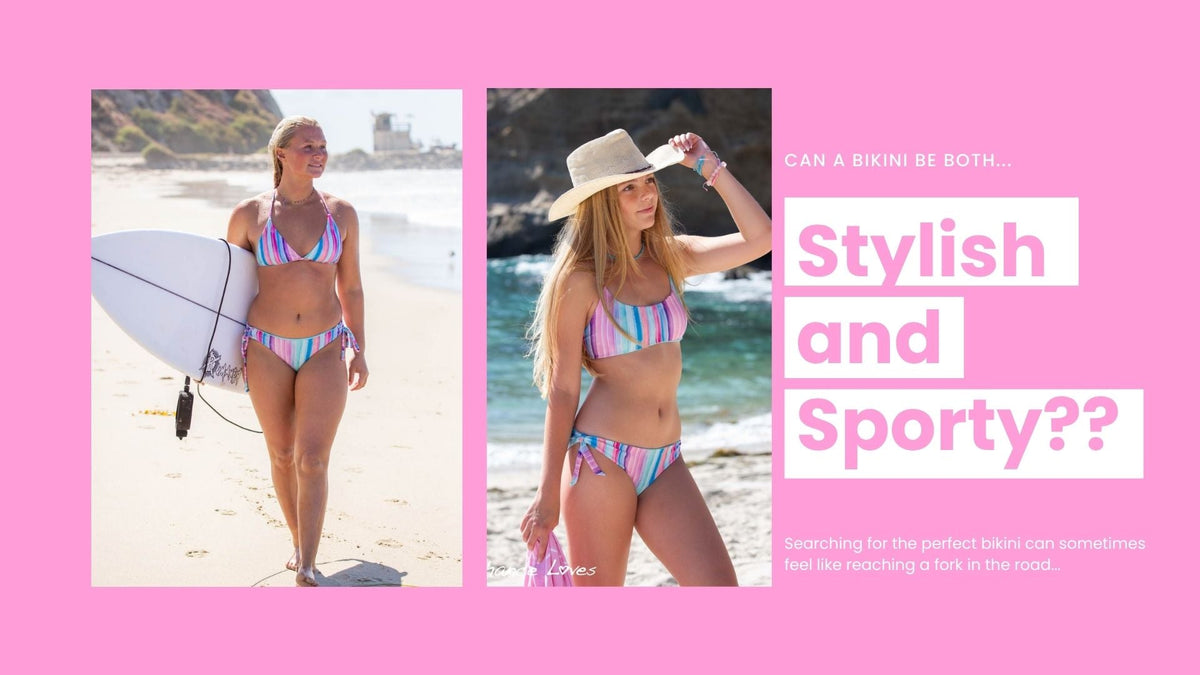
Article: Girls’ versus Women’s Swimwear Sizes: Are They the Same?
Girls’ versus Women’s Swimwear Sizes: Are They the Same?
Girls' Swimwear Sizing: Why "Girls" Doesn't Mean Tiny
Fit notes from the founders of our brand, for girls, tweens, teens, juniors and young women.
If you've ever stood in front of a rack of clothes and seen the word "Girls" on the tag, you probably had one picture in your head: small. Little. Maybe sized for someone half your height. And in most of a closet, that instinct is fair. Girls' jeans are not women's jeans. A girls' size 14 dress is cut for a growing child, and on an adult it often ends up too short, too tight across the shoulders, or just plain wrong.
Swimwear plays by different rules. At our brand, we sell swimwear for girls, tweens, teens and juniors, and we hear the same hesitation all the time: "Isn't that going to be too small for me?" or "My daughter is nearly as tall as I am, will girls' sizing even work?" This post is our long answer. The short version is that swimwear is a fit story, not an age story, and the "Girls" label covers a much bigger range of bodies than most people expect.

Why swimwear isn't like the rest of your closet
Think about what a pair of pants has to do. It has to fit a specific waist, a specific hip, a specific rise and a specific inseam, and it is made from fabric that barely gives. Get any one of those wrong and the whole garment fails. That's why a growing girl moves through pant sizes so quickly, and why adult and girls' pants are so different.
Swimwear has a completely different job. It is designed to hug the body, and it is built from stretch fabric, typically blends with spandex or Lycra, that moulds to whatever shape is inside it. Retailers who write about this say the same thing in different words: the stretch lets a swimsuit conform to your body, and the ideal fit is snug without being restrictive. There is no rise to worry about, no inseam that has to land at a certain point on the leg, and no waistband holding everything up. The fabric does the work.
That is the first reason a girls' swimsuit can fit a much wider range of people than a girls' anything-else. A garment that adjusts to the body in four directions is simply more forgiving than one that doesn't.

The size chart tells the real story
We didn't want to just assert this, so we went and looked at what the major brands publish.
- Nike: Its girls' XL fits up to a 36.5 inch bust, which is a grown woman's size.
- Billabong: Its girls' 16 fits up to a 36.5 inch bust as well.
- Speedo: Girls' and women's sizes use one numbering system, and Speedo says to pick by measurements, not age.
- Roxy: Its girls' 16 swimsuit is made for a 33.5 inch bust, which is in range of their Women's S (33 to 35 inches).
- O'Neill: Its girls' 16 fits up to a 34 inch bust, and its women bikini top Small is for 34 to 35 inches.
Put simply: the line between "girls" and "women" in swimwear is much blurrier than the labels suggest.
Our own size chart: women's and girls' sizes side by side
Our chart pairs each women's size with a girls' size, from XXXS = Girls 8 up to L = Girls 18, and the measurements show how far "girls" really stretches.

Look at the bottom row. Girls 18 covers a 35 to 37 inch bust, 37 to 39 inch hips and a 36C bra, which is a fully grown woman's fit. Girls 14 sits at a 31 to 33 inch bust and 33 to 35 inch hips, the same range Chance has stayed in since she was 14. Centimetre measurements and the full chart are on our size chart page.

It's about your measurements, not your age
Here is a point that comes up again and again in the brands' own guidance: age is a starting point at best. Speedo's size guides say outright that children grow at different rates and that the age printed on the chart should be checked against actual measurements. Another swim-team sizing page we found puts it the same way: competitive suits are sized by chest, waist and hip, not by age, and the age equivalents are only rough ratios.
That is exactly how we think about it. When a customer asks "what size is a 14-year-old?", the honest answer is "it depends on her." A 14-year-old can be 5 feet tall or nearly 5'10". She can be slim or athletic or curvy. What matters is what a tape measure says, and, because the fabric stretches, there is more room for error than you'd have with a pair of jeans.

Example one: one of our founders. She is a woman, 5'9", with a regular build and a 36C bra size. She wears the size L we sell for girls, which our chart pairs with Girls 18 and a 36C bra. She isn't squeezing into something meant for a child. It simply fits, because the cut and the stretch accommodate her. If you're a grown woman reading this and rolling your eyes at the word "girls", this is the reminder that a lot of adults are comfortably wearing it.
Example two: Chance, our co-founder. At 14, Chance wore our size S, which corresponds to Girls 14. Fast forward to age 21. She has grown a couple of inches taller. Her bust size hasn't changed, and her weight is about the same. She still wears the same size 14 swimsuit. Same suit size, seven years apart, and it still fits her.
That second story is the one we tell most often, because it captures how swimwear really works. Height changes, and it changes a lot between the early teens and the early twenties. But the things a swimsuit actually has to fit, bust, waist and hips, often change much less once someone has finished their main growth spurt. A suit that fit at 14 can quite plausibly fit at 21. Try saying that about a pair of jeans.

What actually determines your swimwear size
If age and height aren't the main drivers, what is? Here's what the brands consistently point to, and what we recommend.
Bust first. Speedo's guidance is to use the chest or bust measurement as the primary guide, especially for one-pieces. Their reasoning is practical: the chest is the hardest area to adjust in a one-piece, whereas stretch fabric has more flexibility through the hip and torso. If your chest and hips point to different sizes, go with the one that suits your chest.
Then hips, especially for bottoms. Nike's guidance is that if waist and hip measurements land in two different sizes, choose by hip. For bikini and tankini separates, you can often pick a different size for the top and the bottom.
Torso length matters for one-pieces. Nike's chart includes a torso measurement, taken from the shoulder over the bust, through the legs and back up. This is the one place where height really matters, because a one-piece that is too short will pull at the shoulders and ride up. If you or your daughter is tall, a one-piece is where you want to check torso length carefully. Separates are far more forgiving.
Fit, not just numbers. A good swimsuit should feel secure across the bust and back, without gaping, pulling or riding up. It should be snug, not restrictive. And it's worth remembering that fit also depends on the style: triangle tops and adjustable ties give you more flexibility than molded cups.

How to measure at home
You only need a soft tape measure and a few minutes.
- Bust: Measure around the fullest part of the chest, keeping the tape level all the way around.
- Waist: For bikinis waist size doesn't matter.
- Hips: Measure around the fullest part of the hips and seat, tape level.
- Torso (for one-pieces): Start at the high point of the shoulder, go over the fullest part of the bust, down between the legs and back up to where you started.
Take measurements against bare skin or a thin layer, and compare all of them to the size chart. Then use the rule of thumb above: bust first for tops and one-pieces, hips first for bottoms.
Between sizes? Here's how to decide
This is the question we get asked often, and honestly we don't think this applies to swimwear. Safest would be to go for our pieces that are adjustable, but overall we always advise to size up if not sure.
Our take: let the activity and comfort preference decide.
- Competitive or lap swimming: go snug. You want the suit to stay put and not drag.
- Beach, pool days and vacations: if you like a little room, or you're between sizes in the bust, size up.
- Growing girls: We advise sizing to current measurements rather than buying bigger for growth. Because swimwear is so forgiving, a well-fitted suit often lasts longer than you'd think, as the Chance story shows.

"But the label says Girls..."
We'd like to gently retire a few assumptions.
"Girls' sizing is tiny." Not at the top end, and our line runs all the way up to Girls 18. As the charts above show, girls' sizes 14 and 16 measure up to bust and hip numbers that overlap with women's XS and S at major brands.
"If it says 14, it's for a 14-year-old." The number is a size, and the age is a rough guide. Plenty of girls are in a different size from the one their birthday suggests, and plenty of adults happily wear a girls' size 14 or 16.
"She'll outgrow it next summer." Sometimes, sure. But height is the part of growth that matters least for a stretch swimsuit. If her bust, waist and hips stay in the same range, she may well be wearing the same size for years.
"An adult can't wear girls' swimwear." An adult whose measurements fall in the range absolutely can. We're proof, with a 36C and a 5'9" frame in a size L.

A quick word on brand-to-brand differences
Because there is no universal standard, a size S/Girls 14 from one brand is not guaranteed to be identical to a size 14 from another. Swimwear sizing varies by brand and by style, and many guides recommend always checking the specific brand's chart instead of assuming your usual clothing size. Some brands go further and suggest using your underwear size as a guide, on the grounds that swimwear and underwear are both designed to hug the body.
The takeaway is the same everywhere: measure, check the chart for the brand you're buying, and don't rely on the number on the tag from a different brand or a different type of clothing.
The bottom line
When you hear "girls' sizing," try not to hear "tiny." In swimwear especially, the label covers a wide range of heights, builds and ages. The fabric stretches, the garment hugs rather than hangs, and there are no pant legs or waistbands to complicate things. What counts is bust, hips and, for one-pieces, torso length.
So whether you're shopping for an eight-year-old, a lanky fourteen-year-old, a twenty-one-year-old who hasn't changed sizes in years, or yourself, grab a tape measure, check our size chart, and trust the numbers over the word on the label. And if you're ever unsure, reach out. We'd rather help you find the right fit than see you guess.
Have a sizing question we didn't cover? Send us a message with your measurements and we'll help you pick.